The Magic of Compound Interest: How Small Savings Become Big Money
There's a reason compound interest gets called the eighth wonder of the world. It's the closest thing personal finance has to a superpower — and the earlier you understand it, the richer it can make you. Here's how it works, and how to put it to work.
Imagine two friends. Aisha starts investing $200 a month at age 25 and stops completely at 35 — just ten years of saving, $24,000 total. Ben waits until 35, then invests the same $200 a month faithfully until he's 65 — thirty years, $72,000 total. Ben puts in three times as much money for three times as long. Yet at 65, assuming a 7% annual return, Aisha ends up with roughly the same amount as Ben, or more. How is that possible? One word: compounding. Let's unpack the most important idea in personal finance.
Simple interest vs. compound interest
To appreciate compounding, you first have to see what it's beating. Simple interest is calculated only on your original amount — the principal. Put $1,000 in an account paying 10% simple interest and you earn $100 every year, forever. After 30 years you'd have your $1,000 plus $3,000 in interest: $4,000. Predictable, linear, and frankly a little boring. You can model it with our Simple Interest Calculator.
Compound interest is different in one crucial way: you earn interest on your interest. In year one, your $1,000 earns $100. But in year two, you earn 10% on $1,100 — that's $110. In year three, 10% on $1,210. Each year your balance grows a little faster than the year before, because the base it's growing from keeps getting bigger. After 30 years at 10% compounded annually, that same $1,000 becomes about $17,449 — more than four times what simple interest produced, from the exact same starting point.
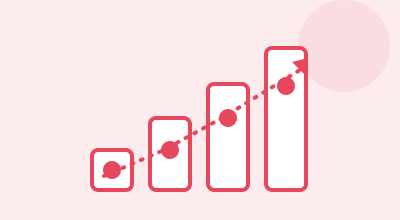
Simple interest grows in a straight line. Compound interest grows in a curve that gets steeper the longer you wait. The magic isn't the rate — it's the curve.
Why time is the secret ingredient
That curve is the whole story, and it explains Aisha and Ben. Compounding rewards time even more than it rewards the amount you save. The money Aisha invested in her twenties had forty years to compound; every dollar she added early got doubled and redoubled again and again. Ben's dollars, added later, simply didn't have as many years to multiply.
The steepest part of the curve is always at the end. In a decades-long investment, the growth in the final ten years often dwarfs everything that came before — but you only reach that steep part if you started early enough to still be invested. This is why the single most powerful move in investing is simply to begin. You can watch this play out with our Compound Interest Calculator: try the same monthly contribution starting at 25 versus 35 and watch the final balances diverge dramatically.
The rule of 72
Here's a mental shortcut worth memorizing. To estimate how many years it takes for money to double at a given annual return, divide 72 by the interest rate. At 8%, money doubles about every nine years (72 ÷ 8 = 9). At 6%, every twelve years. At 10%, roughly every seven.
This simple trick reveals why small differences in return matter enormously over time. An investment earning 8% doubles nearly twice as often over a lifetime as one earning 4%, which is why fees and interest rates that look trivial — one or two percentage points — can mean the difference of hundreds of thousands of dollars by retirement.
The variables that drive compounding
Four levers control how much your money grows. Understanding them lets you pull the ones within your control.
- Principal — how much you start with. Helpful, but the least important lever for most people.
- Contributions — how much you add regularly. Steady monthly contributions are the engine of real-world wealth building.
- Rate of return — how fast it grows each year. Higher is better, but higher returns usually mean higher risk.
- Time — how long it compounds. The most powerful lever of all, and the one you can never get back once it's gone.
Notice that three of the four favour patience and consistency over cleverness. You don't need to pick winning stocks or time the market. You need to start early, contribute regularly, keep costs low, and let time do the heavy lifting.
Compounding frequency
Interest can compound annually, quarterly, monthly, or even daily. The more often it compounds, the slightly faster your money grows, because your interest starts earning interest sooner. The difference between annual and monthly compounding is modest but real, and it's why banks advertise APY (annual percentage yield, which accounts for compounding) rather than just the nominal rate. When comparing savings accounts, our Savings Calculator lets you see how a given APY grows your balance over time.
Compounding works against you, too
Here's the sobering flip side: the same force that builds wealth in a savings account destroys it in debt. Credit card balances compound against you, often at 20% or more. Carry a balance and the interest is added to what you owe, so next month you're charged interest on the interest — the exact same curve, now pointing the wrong way.
This is why high-interest debt is such a wealth-killer and why paying it off is often the best "investment" you can make. Clearing a card charging 22% is a guaranteed 22% return, tax-free. Before you invest a dollar, it's usually worth using our Credit Card Payoff Calculator to see how fast you can escape that reverse-compounding trap.
A worked example you can feel
Numbers on a page are abstract, so let's make compounding concrete. Suppose you invest $300 every month and earn an average 7% a year — a reasonable long-run assumption for a diversified stock portfolio. After ten years you'd have contributed $36,000, and your balance would be roughly $52,000. Nice, but not dramatic. Keep going. After twenty years you've put in $72,000, and the balance is around $156,000 — more than double your contributions. After thirty years, $108,000 of contributions has become roughly $366,000. And after forty years, $144,000 in has grown to over $787,000.
Look at the pattern in those numbers. In the first decade your money grew by about $16,000 beyond what you put in. In the final decade, it grew by more than $400,000 beyond contributions. You didn't save more in those later years — you saved exactly the same $300 a month throughout. The acceleration came entirely from compounding on a bigger and bigger base. That is the curve doing its work, and it's why the phrase "time in the market" carries so much weight.
The enemies of compounding
If time and consistency are compounding's best friends, three things are its enemies. The first is fees. A fund charging 1% a year instead of 0.1% doesn't cost you 0.9% — it costs you 0.9% compounded over your entire investing life, which can quietly consume a fifth or more of your final balance. Always know what you're paying. The second enemy is interruption. Every time you cash out, pause contributions, or panic-sell in a downturn and buy back higher, you break the chain and reset part of the curve. The investors who do best are often simply the ones who did nothing for the longest. The third enemy is inflation, which erodes the real value of money that isn't growing fast enough — the reason cash under a mattress slowly loses purchasing power while invested money can outrun it.
Notice that none of these enemies require market-timing genius to defeat. Keep costs low, keep contributing, and stay invested through the scary stretches. Compounding rewards the patient far more than the clever, which is wonderful news — because patience is a skill anyone can practice.
Key takeaways
- Compound interest means earning interest on your interest — growth accelerates over time.
- Time matters more than the amount; starting early can beat saving more later.
- Use the rule of 72 (72 ÷ rate) to estimate how fast money doubles.
- Regular contributions plus low costs plus patience is the reliable formula.
- The same force compounds debt against you — clear high-interest balances first.
How to make compounding your ally
The practical playbook is refreshingly simple. First, eliminate high-interest debt so compounding stops working against you. Second, start investing as early as you possibly can, even with small amounts — a modest sum today beats a large sum years from now. Third, automate regular contributions so you never have to rely on willpower. Fourth, keep fees low, because a 1% annual fee quietly steals a slice of your compounding curve every single year. Finally, leave it alone. The hardest and most valuable part of compounding is resisting the urge to interrupt it. Wealth built this way is boring to watch and thrilling to arrive at.
Getting started when you have almost nothing
One of the biggest myths about compounding is that you need a large sum to begin. You don't — you need to begin, full stop. Because time is the dominant force, a small amount invested consistently in your twenties can outgrow a much larger amount started later. The practical first steps are simple and available to almost everyone. Open a low-cost investment account, set up an automatic transfer of whatever you can genuinely afford — even a modest weekly or monthly amount — and choose a broad, diversified, low-fee fund rather than trying to hand-pick winners. Then let it run.
The magic is in the automation and the consistency, not the size of the first deposit. Investing a fixed amount on a schedule, regardless of whether markets are up or down, is a strategy sometimes called dollar-cost averaging, and it removes the impossible task of timing the market. When prices are low your money buys more; when they're high it buys less; over decades it smooths out. As your income grows, increase the amount — ideally by directing a slice of every raise straight into investing before you get used to spending it. What feels like a trivial sum today, left alone and topped up steadily, is exactly the kind of small seed that compounding turns into something remarkable. The investors who end up wealthy are rarely the ones who started with the most; they're the ones who started the earliest and never stopped.
Frequently asked questions
What is compound interest in simple terms?
It's interest earned on both your original money and the interest you've already earned. Because your balance keeps growing, each period's interest is calculated on a larger amount, so growth speeds up over time.
How is compound interest different from simple interest?
Simple interest is calculated only on your original principal, so it grows in a straight line. Compound interest is calculated on principal plus accumulated interest, so it grows in an accelerating curve.
How often should interest compound?
More frequent compounding (daily or monthly) grows money slightly faster than annual compounding, but the difference is small compared with the effects of time, rate and contributions.
What is the rule of 72?
Divide 72 by your annual return to estimate how many years it takes your money to double. At 8%, that's about nine years.
Is compound interest good or bad?
Both. It builds wealth powerfully when you're saving or investing, and it destroys wealth when you carry high-interest debt. The goal is to be on the earning side of the curve.
How much do I need to invest to become wealthy?
Less than most people think, if you start early. Modest, consistent monthly contributions over several decades can grow into a substantial sum thanks to compounding.
See your money grow
Plug in a starting amount, a monthly contribution and a rate to watch compounding build your future balance.
Open the Compound Interest Calculator →